

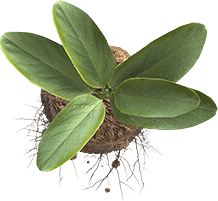

Hydroponic agriculture is a soilless farming method in which plants are grown using water-based fertiliser solutions that deliver vital minerals and water directly to their roots rather than soil. This method encourages faster growth, higher yields, and greater water conservation, making it suitable for a wide range of circumstances, including those with poor soil, limited area, and water constraints. Hydroponic systems can be liquid, with roots directly exposed, or they can support the roots with an inert material like perlite or coconut coir.
Plants don’t require soil for the photosynthesis process. In conventional farming, plants want the soil to supply them with water and nutrients. Hydroponic methods have demonstrated that it can provide adequate water and nutrients without soil.
Hydroponic farming offers various advantages over traditional crop cultivation. Hydroponics offers plant roots with a limitless supply of oxygen and water. Hydroponic farming minimises errors by managing air, water, and nutrients for optimal results. Traditional methods have serious problems, such as soil erosion and water waste. Hydroponic agriculture has the potential to address various challenges.
1. Hydroponics saves space.
Plants in soil require more space to spread their roots and receive water and nutrients. The plants were then separated. Because nutrients and water are provided adequately in hydroponics, plant roots do not require space to spread. Hydroponic agriculture produces more plants in the same area as soil-based agriculture.
2. Hydroponics. Conserve water.
Field cultivation requires water because so much is lost. Much field water evaporates, rolls away, and puddles, making it unusable.
3. Several chemical applications:
Hydroponic farming minimises pests but does not remove them. Hydroponics uses fewer pesticides and herbicides since it is controlled. Such devices are used indoors, where pests cannot infiltrate, reducing pesticide use.
4. Hydroponic Nutrient Control.
Hydroponics provides food without the need for soil or a large open space. Hydroponic farming feeds plants with nutrient-rich liquid solutions, giving farmers better control over crop nutrition.
5. It results in a higher yield.
Hydroponic farming is said to yield more plants than soil-based farming. This is owing to the capacity to control lighting, moisture, temperature, and nutrients, all of which help plants grow. The plants are appropriately positioned and provided the necessary nutrients to reach their root systems. Hydroponics grows plants 30–50% faster than soil. Plant development benefits from optimal nutrient levels.
Hydroponics farming can be done outside, inside a greenhouse, or under artificial lighting.
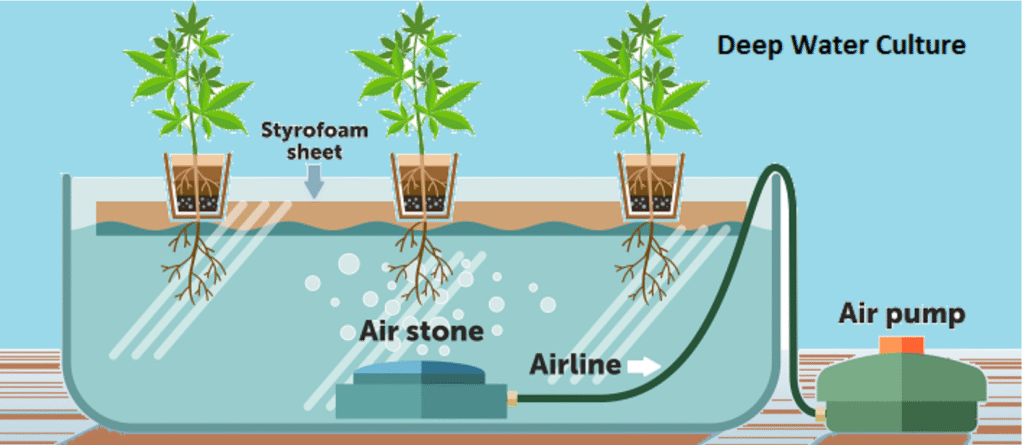
1. Deep Water Culture:
DWC (Deepwater Culture System) hydroponics utilises a static nutrient solution. Plant roots float in the nutritious solution. Deep water culture is one of the simplest hydroponic systems where a plant’s root is submerged in nutrient solution. Farmers must replace the fertiliser solution every 5-10 days, depending on the number of systems and plant volume.
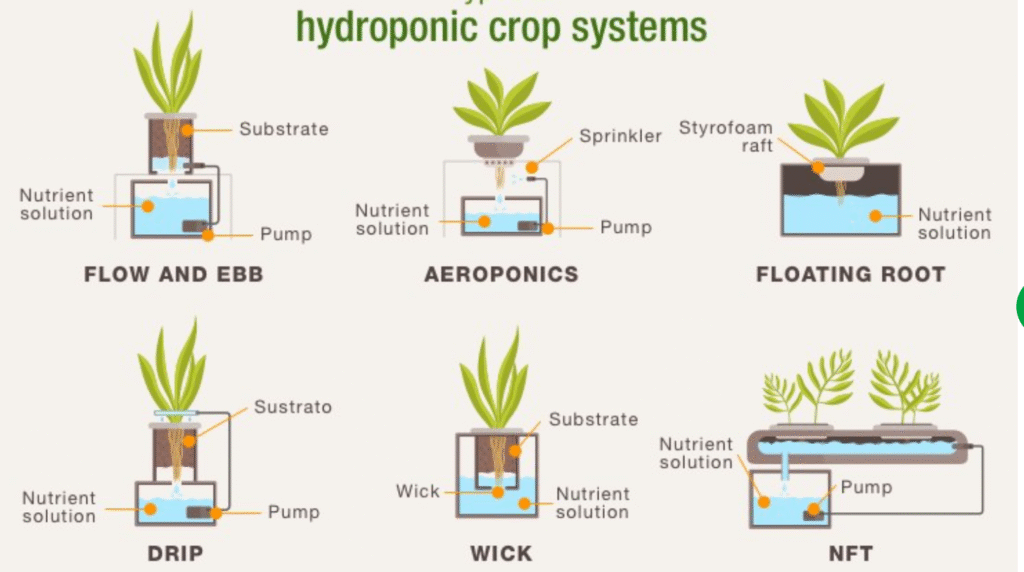
The wick system is another of the easiest soilless hydroponic growing methods. It refers to a hydroponic growing setup that makes use of soft fabric string or wick. It’s one of the passive hydroponic systems that doesn’t require any mechanical parts like an air pump to function.
In the wick system, the wick secures a steady supply of nutrient solution from the reservoir or tank. Wicks do these tasks by traveling from the reservoir to the growing tray. Nutrients flow up the wick through capillary action and saturate the growing media around the roots.
Growers can make wicks using materials like felt, rope, or string. The wick system uses various types of growing media.
Below are the three most suitable growing media for hydroponic wick systems:
However, the wick system is a bit slow compared to other hydroponic systems. In the Wick system, each plant in the growing tray must have at least one wick running from the reservoir.
3. NFT: Nutrient Film Technique
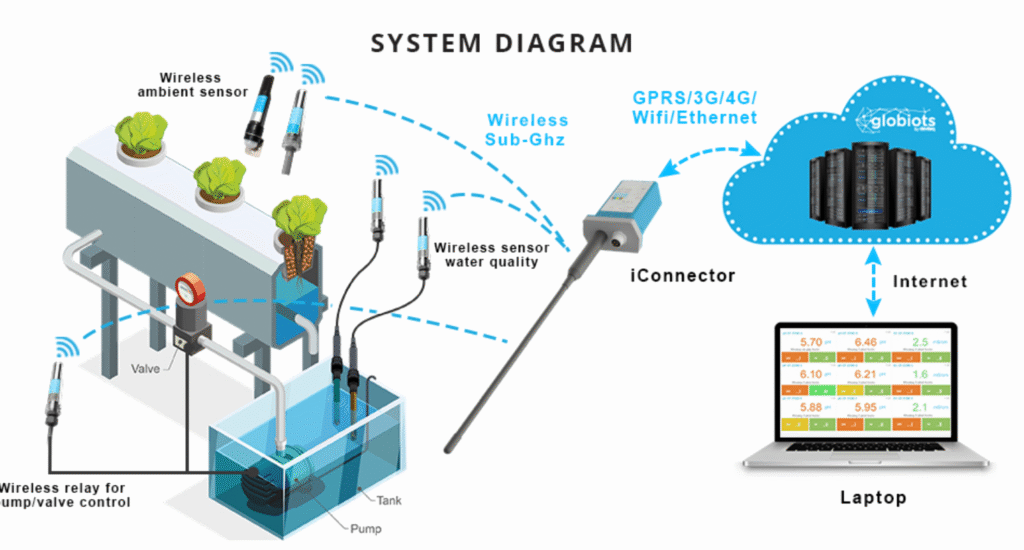
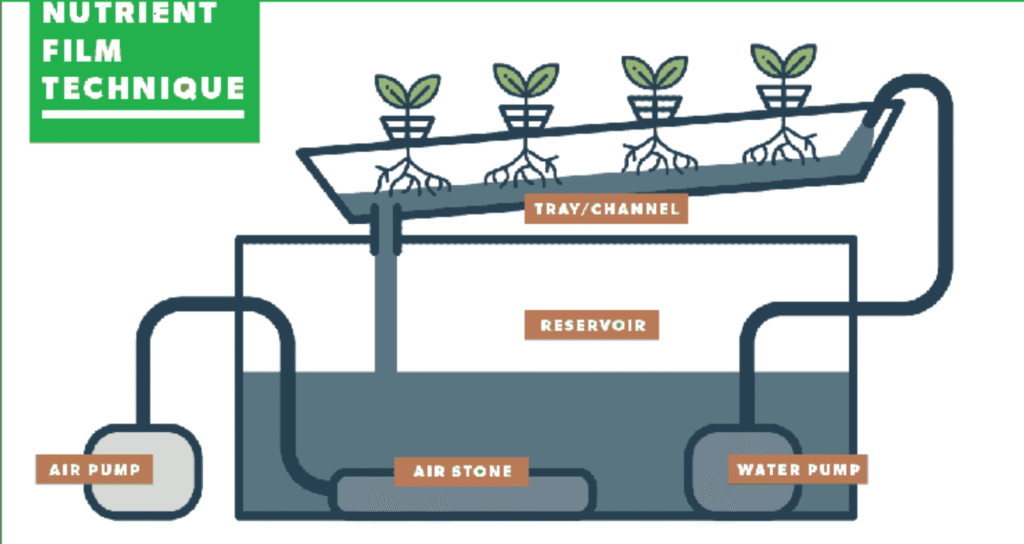
Nutrient Film Technique (N.F.T.) is a popular active hydroponic system. It uses pumps to distribute a thin film of nutrients through shallow channels where plants’ roots can sink to receive nutrients.
There are a few key components of N.F.T. systems that work together to run the system. These are growing trays, water pumps, air stones, and nutrient solutions.
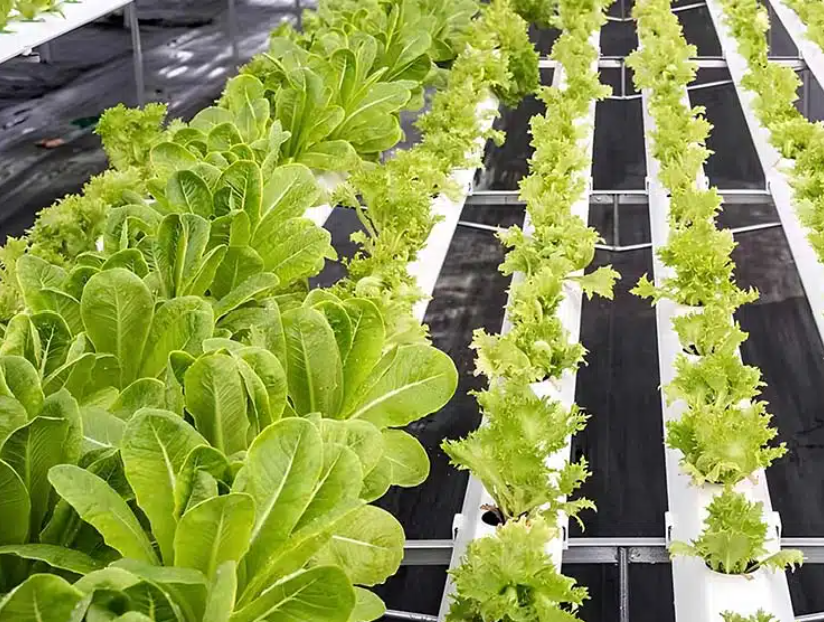
N.F.T hydroponics consists of a slopping (a shallow channel or tube) through which a film nutrient solution flows. Plants are placed in small holes or cups in this channel. It lets the plant’s root dangle into the flowing solutions.
A nutrient solution containing water and essential minerals is continuously pumped into one of the channels. It flows one of the bottoms of the channel that bathes the roots of the plants as it passes by.
After passing over the roots the nutrient solution drains down the channel and is collected at the other end. Again, this drain solution is recirculated.
It’s our recommendation to use net pots in the N.F.T. hydroponics systems. However, N.F.T. doesn’t accommodate larger plants but it does scale well.
The best-suited plants for N.F.T systems are leafy green plants. Bibb and leaf-type Lettuce are ideal as well. You can grow other leafy plants like spinach and broccoli in N.F.T systems.
4. Aeroponic Hydroponics
An aeroponic system represents an innovative and efficient approach to plant cultivation. In aeroponic, the plant’s roots are suspended in the air and exposed their naked roots to a nutrient-filled mist.
Here are some key aspects of aeroponics:
Framework and Design: Aeroponic systems are typically designed as enclosed structures, often resembling cubes or towers.
Nutrient Delivery: Water and nutrient solutions are stored in a reservoir and pumped to a nozzle, where they are atomized into a fine mist. This mist is released from the top of the tower.
Root Exposure: Aeroponic systems maintain continuous exposure of plant roots to nutrient mist. Some systems mimic the constant nutrient film technique (N.F.T.) and others follow the ebb and flow system.
No Substrate Media: Aeroponic hydroponic systems don’t rely on substrate media. The open-air environment promotes efficient oxygen.
The most suitable plants for aeroponics are tomatoes, lettuce, leafy greens, cucumbers, peppers, and carrots.
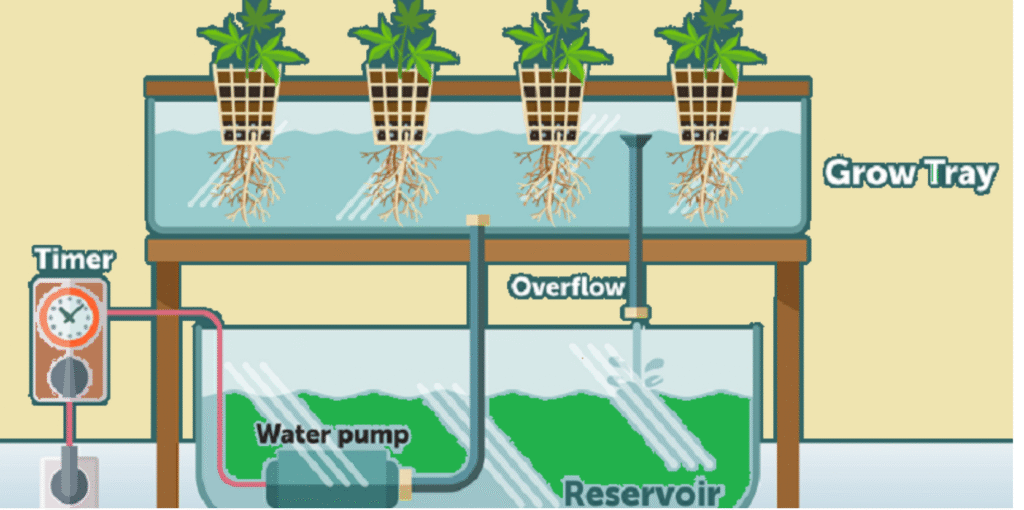
Ebb and Flow, also known as Flood and Drain is one of the recognized hydroponic system. This system operates on a cyclic basis. It provides water and nutrients to the plants periodically which creates an environment conducive to the healthy growth of plants.
Here is a list of major components of Ebb and Flow hydroponic gardening and how they work together:
Growing Trays: This is where the plants are placed.
Reservoir: A container that holds the nutrient solutions.
Submersible pump: The pump is responsible for moving the nutrient solutions.
Timer: The timer gives you control regarding the pump. It helps to decide when to flood and when to drain the system.
Grow Medium: A substrate like a coco coir, rock wool, and clay pellets are used to support the plants.
The cycle begins when the timer activates the submersible pump. The submersible pump floods the growing tray with nutrient solutions. Growing medium growers have used absorb the nutrients and give water and nutrients to the plant’s roots.
Then, after 15-30 minutes, the timer shuts off the pump, and the nutrient solution drains back into the reservoir by gravity. Draining makes sure that the plant roots have access to both water and oxygen.
The best-suited plants for the Ebb and Flow hydroponic system are tomatoes, Kale, Cucumber, and Lettuce.
6. Netherlands’ Bucket Grow System
As the name suggests, it grows plants in buckets. The grower can easily modify the bucket size. The bucket contains vermiculite to support the plant. Hydroponics uses the Dutch bucket growing technique for plants with longer roots, such as tomatoes and cucumbers.
The NFT method is ideal for growing kale and lettuce. However, the Dutch Bucket Grow System is superior for cucumber and tomato cultivation.
7. Hydroponic Drip System
In a drip hydroponic system, a tube or hose with tiny holes (like dripping faucets) carries water and nutrients to each plant. In this way, plants get exactly what they need, and there’s less waste.
There are two types of drip system: recovery and non-recovery. In a recovery drip system, excess water that is not absorbed by plants is collected and recirculated back into the system.
In a non-recovery drip system, excess water not taken up by plants is discarded. This system is simple and often used where there is plenty of water.
Excellent Services
Lorem ipsum dolor sit amet, consectetur adipiscing elit.
Certified Experts
Lorem ipsum dolor sit amet, consectetur adipiscing elit.
Phone Number
+91 9696463077
Email Address
Info@regenfarmtech.com
Location
Akhari, Akhari Bypass City/District Varanasi, State:U.P. PIN:221011
Lorem ipsum dolor sit amet, consectetur adipiscing elit. Ut elit tellus, luctus nec ullamcorper mattis, pulvinar dapibus leo.
© 2025 Regen. All Rights Reserved. Developed By Dizi Global Solution