



You are welcome to get in touch with us. Now is the perfect opportunity to cultivate your crops using the RegenTM scientific approach. Let’s consult our expert. info@regenfarmtech.com sales@regenfarmtec.com
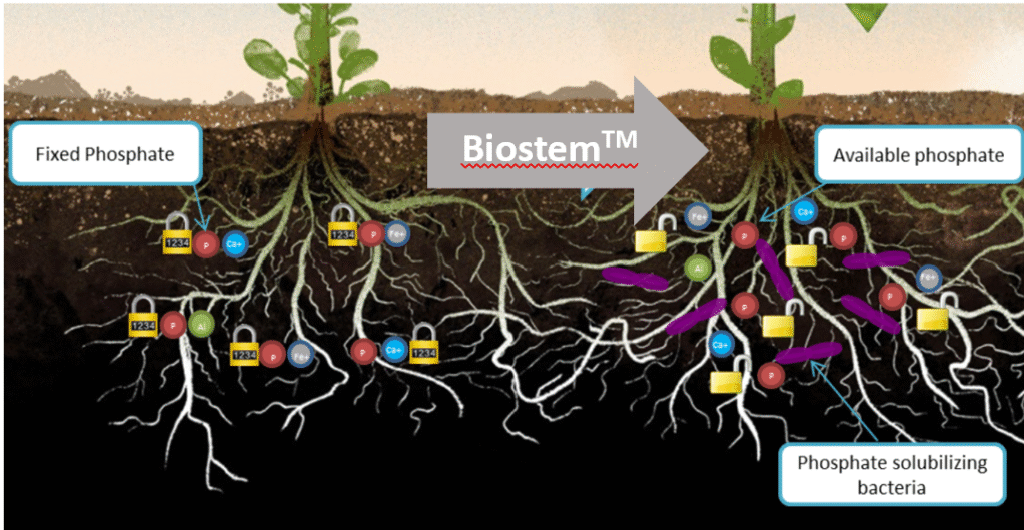
Phosphorus is essential to plants throughout the growing season and is especially important during early development. Good P nutrition can lead to earlier plant emergence, better early plant growth and earlier plant maturity. Phosphorus can be added to your soil in various ways, with inorganic phosphate fertilisers being one of the most common methods used by growers. Inorganic fertiliser is created from rock phosphates that are mined and turned into common end products. For example, dry products such as Monoammonium Phosphate (MAP) and Diammonium Phosphate (DAP), as well as liquid products such as super phosphoric acid, come from rock phosphates. But not all of your applied P fertiliser will remain in plant-available form. Phosphorus gets fixed in the soil by binding with minerals (like Ca, Fe, and Al) , which creates phosphate deposits that are unusable by plants. This procedure means a large portion of your applied P fertiliser will not be available for your plant’s uptake.
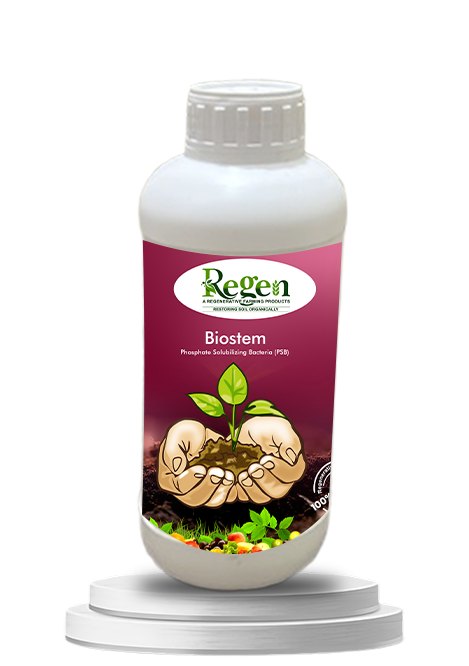
A cost-effective and eco-friendly way to improve the efficiency of your fertiliser applications is to use BiostemTM. Biostem™ contains P-solubilising bacteria that break down the P deposits and liberate the phosphates from them. This creates plant-available forms of P (H₂PO₄⁻ or HPO₄²⁻) and increases availability of P in the soil for your crops. These bacteria don’t just increase the P coming from your fertilisers. These unique bacteria also free up other phosphates, either naturally present in the soil or left over from previous fertiliser applications. Making these phosphates plant-available allows farmers to make the most of your fertiliser investments and soil P already in their fields.
Biostem™ contains a group of phosphate-solubilising microorganisms (PSMs—bacteria or fungi) that are capable of breaking down insoluble forms of phosphorus, such as phosphates, in the soil and making it available to plants in a soluble form that can be easily absorbed. Biostem™ has a vast category of beneficial microbes, including many genera, for instance. Bacillus spp., Pseudomonas spp., Streptomyces spp., Aspergillus spp., Rhizobium spp., Fusarium spp., Trichoderma spp., Penicillium spp., Serratia spp., Micrococcus spp., Stenotrophomonas spp., Acinetobacter spp., and Agrobacterium spp. It is generally accepted that the mechanism of mineral phosphorus solubilisation by strains of phosphorus-solubilising bacteria (PSB biofertilisers) is associated with the release of low molecular weight organic acids, such as formic, acetic, propionic, lactic, glycollic, fumaric, and succinic acids, as well as acidic phosphatases like phytase that are synthesised by soil microorganisms.
Nowadays, a large portion of soluble inorganic phosphorus, which is applied to the soil as chemical fertiliser, is immobilised rapidly and becomes unavailable for plants. But currently, the main purpose in managing soil phosphorus is to optimise crop production and minimise P loss from soils. Biostem™ increases the overall availability of phosphorus for plants, leading to improved plant growth and crop yields. PSMs are commonly found in soil and the rhizosphere and play an important role in nutrient cycling and soil fertility, such as an increased rate of photosynthesis, improved root development, and an enhanced ability to defend against stressors such as drought or disease. PSMs can enhance plant endogenous gene expression and help plants cope with abiotic stress by providing an increased availability of soluble phosphorus. This increased availability of phosphorus can activate signalling pathways and trigger the expression of stress-responsive genes in plants, which can enhance their ability to tolerate and resist environmental stressors such as drought, salinity, heavy metal toxicity, and extreme temperatures. For example, research has shown that PSMs can increase the expression of genes involved in the regulation of water uptake, antioxidant defence, and heat shock responses, which can help plants better cope with abiotic stress. In addition, PSMs can also stimulate the production of phytohormones, such as auxins, cytokinins, gibberellins, et al., which can enhance plant growth and stress tolerance.
PSMs can play a role in remediation of heavy metal pollution in soil by indirectly reducing the bioavailability of heavy metals. When PSMs solubilise phosphates, they create a competition for metal ions, which can reduce plant uptake of heavy metals and lower their concentration in the soil alone or when combined with other species or materials. In addition, some PSMs have been shown to produce organic acids, such as citric acid, that can chelate heavy metals and make them less available for uptake by plants.
Another way PSMs can help remediate heavy metal pollution in soil is by promoting the growth of plants that can tolerate high levels of heavy metals. This is known as phytoremediation, and it involves using plants to remove heavy metals from the soil by absorbing and accumulating them in their tissues. PSMs can help improve the growth and health of these phytoremediation plants by providing them with an available source of phosphates, which are essential for plant growth and development.
Mechanisms of Inorganic Phosphate Solubilisation by Biostem™:
The principal mechanism is the production of mineral-dissolving compounds such as organic acids, siderophores, protons, hydroxyl ions and organic acids produced together with their carboxyl and hydroxyl ions chelate cations or reduce the pH to release P. The excretion of these organic acids is accompanied by a drop in pH that results in the acidification of the microbial cells and the surroundings; hence, P ions are released by the substitution of H+ for Ca2+. Of all the organic acids, gluconic acid is the most frequent agent of mineral phosphate solubilisation; it chelates the cations bound to phosphate, thus making the phosphate available to plants.
Mechanisms of Organic Phosphorus Mineralisation by Biostem™:
The major source of organic phosphorus in soil is the organic matter. The values of organic phosphorus in soil can be as high as 30–50% of the total P, and soil organic P is largely in the form of inositol phosphate (soil phytate). Other organic P compounds are phosphomonoesters, phosphodiesters, phospholipids, nucleic acids, and phosphotriesters. In addition, large quantities of xenobiotic phosphonates (pesticides, detergent additives, antibiotics, and flame retardants) that are regularly released into the environment also contain organic P. Most of these organic compounds are high molecular-weight materials that are generally resistant to chemical hydrolysis and must therefore be bio-converted to either soluble ionic phosphate (Pi, HPO₄²⁻, H₂PO₄⁻) or low molecular-weight organic phosphate to be assimilated by the cell.
Phosphorus mineralisation refers to the solubilisation of organic phosphorus and the degradation of the remaining portion of the molecule. One important theory for the solubilisation of organic P is the sink theory. This refers to continuous removal of P that results in the dissolution of Ca-P compounds. Consequently, the decomposition of P in organic substrates is consistently correlated with the P content in the biomass of PSM. This biological process plays an important role in phosphorus cycling. Different groups of enzymes are involved in this. The first group of enzymes are those that dephosphorylate the phosphor-ester or phosphoanhydride bond of organic compounds. They are non-specific acid phosphatases (NSAPs). The most studied among these NSAP enzymes released by PSM are the phosphomonoesterases, also referred to as phosphatases. These enzymes can either be acid or alkaline phosphomonoesterases. The pH of most soils where phosphate activities were reported ranges from acidic to neutral values. This signifies that acid phosphatases play the major role in this process.
Another enzyme produced by PSM in the process of organic P mineralisation is phytase. This enzyme is responsible for the release of phosphorus from organic materials in soil (plant seeds and pollen) that are stored in the form of phytate. Phytate degradation by phytase releases phosphorus in a form that is available for plant use. Plants generally cannot acquire phosphorus directly from phytate; however, the presence of PSM within the rhizosphere may compensate for a plant’s inability to otherwise acquire phosphorus directly from phytate.
Factors Influencing Microbial Phosphate Solubilisation
Factors affecting efficiency of Biostem™:
1. Normal PSB efficiency is more in extreme environments, such as saline-alkaline soils, soils with a high level of nutrient deficiency, or soils from extreme temperature environments, which have the tendency to solubilise more phosphate than soils from more moderate conditions, but Regenerative Farming Technologies – BiostemTM solubilises fixed phosphorus in the wide range of temperatures from the optimum temperature of 20–25°C to the extreme temperature of 45°C in desert soil.
2. Interactions with other microorganisms in the soil, the extent of vegetation, ecological conditions, climatic zone soil types, plant types, agronomic practices, land use systems, and the soil’s physicochemical properties, such as organic matter and soil pH.
A. Phosphorus is solubilised faster in warm humid climates and slower in cool dry climates.
B. Well-aerated soil will more readily permit rapid phosphorus solubilisation compared to saturated wet soil.
C. Adding small amounts of inorganic phosphorus to the rhizosphere could drive phytic acid mineralisation by bacteria and thereby improve plant phosphorus nutrition.
D. Lime and compost, used as a soil improver, also had positive effects on phosphate solubilizers.
E. Phosphorus Solubilising bacteria population richness and diversity, more abundant and diverse following crop rotation.
F. Soil rich in organic matter will favour microbial growth and therefore favours microbial phosphorus solubilisation.
G. Soil pH values between 6 and 7.5 are best for P-availability; this is because pH values below 5.5 and between 7.5 and 8.5 limit P from becoming fixed by aluminium, iron, or calcium, and hence, not being available for plant use.
Application Method and Dosage:
Seed treatment – Mix 5 ml of Biostem with 50–100 ml of water for a small quantity of seeds; for treating seeds on 1 acre, mix 250 ml of Biostem with 1–5 L of water. Thoroughly mix the SoilPSB-water solution with the seed and shade-dry for one hour before sowing the treated seed.
Seedling treatment – Mix 50 ml of Biostem with one L of water for a small number of seedlings; for treating seedlings on one acre, mix 250 ml of Biostem with 1–5 L of water. Seedlings may be immersed in Biostem-water solution for approximately 30 minutes prior to transplantation.
Soil Application—Mix 2.0 L of Biostem with 10 bags of BioMitra compost per acre, and subsequently distribute this mixture in the field either prior to planting or within 45 days post-sowing in an established crop, followed by irrigation of the field.
Drip irrigation: Mix 5 ml of Biostem in 1 L of water or 1-2 L of Biostem per acre for each application. Apply the mixture by either drenching or dripping it onto moist soil, and repeat this treatment every 30 days to achieve optimal results.
During the crop cycle, administer 6–10 L per acre of Biostem to achieve optimal results and reduce the application of commercial nitrogen fertiliser by up to 50%.
Target Crops – This product is suitable for application in soil for both leguminous and non-leguminous crops such as cereals, vegetables, fruits, oil crops, flowers, pulses, and others.
Benefits –
Storage and Management:
Compatibility:

BiostemTM is available in packet quantities of 250 gm/ml, 500 gm/ml, and 1 kg/L.
We respect your opinion; if you have a concern, please contact the customer service representative at
Mob: 9696463077
Email: info@regenfarmtech.com
sales@regenfarmtech.com
Only for agricultural use.
Please remove the label, rinse the bottle, and return it for recycling.
Made in India.
Finibus Bonorum et Malorum" (The Extremes of Good and Evil) by Cicero, written in 45 BC. This book is a treatise on the theory of ethics, very popular during the Renaissance. The first line of Lorem Ipsum, "Lorem ipsum dolor sit amet..", comes from a line

Finibus Bonorum et Malorum" (The Extremes of Good and Evil) by Cicero, written in 45 BC. This book is a treatise on the theory of ethics, very popular during the Renaissance. The first line of Lorem Ipsum, "Lorem ipsum dolor sit amet..", comes from a line

Finibus Bonorum et Malorum" (The Extremes of Good and Evil) by Cicero, written in 45 BC. This book is a treatise on the theory of ethics, very popular during the Renaissance. The first line of Lorem Ipsum, "Lorem ipsum dolor sit amet..", comes from a line


Phone Number
+91 9696463077
Email Address
Info@regenfarmtech.com
Location
Akhari, Akhari Bypass City/District Varanasi, State:U.P. PIN:221011
Lorem ipsum dolor sit amet, consectetur adipiscing elit. Ut elit tellus, luctus nec ullamcorper mattis, pulvinar dapibus leo.
© 2025 Regen. All Rights Reserved. Developed By Dizi Global Solution