Every live cell requires potassium (K), a vital nutrient. Soils contain more potassium than any other nutrient, but the majority of it is unavailable to plants. Chemical fertilisers affect soils and ecosystems. Potassium-solubilising bacteria (KSB) can convert insoluble K-containing minerals into soluble forms that plants can absorb.
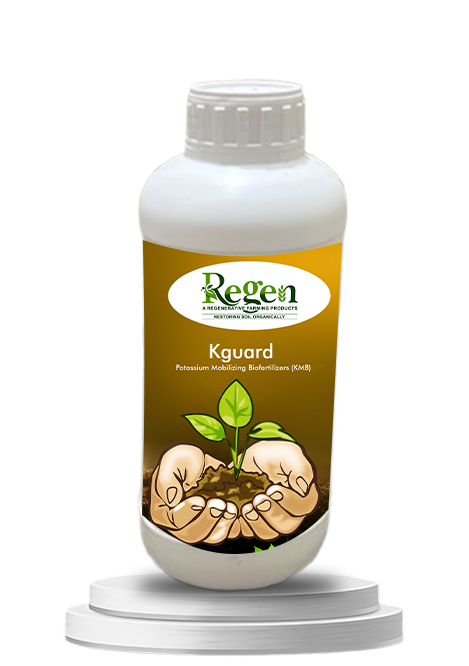
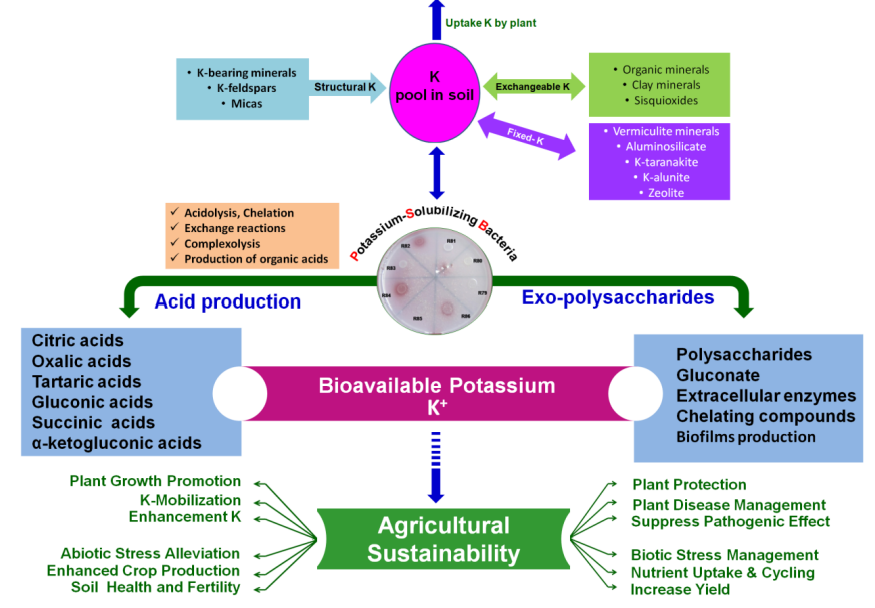
Acidothiobacillus ferrooxidans, Paenibacillus spp., Bacillus megaterium, B. mucilaginous, B. mucilaginosus, B. edaphicus, and B. circulans are all capable of dissolving potassium minerals. KSBs are present in all soils, but their quantity, variety, and K solubility vary with soil and climate. KSB uses organic and inorganic acids, acidolysis, polysaccharides, complexolysis, chelation, and exchange reactions to dissolve silicate minerals and liberate potassium. The main byproduct, glutonic acid, solubilises potassium, increasing plant nutrition’s availability. KgardTM is a beneficial alternative to conventional K fertiliser since it contains numerous KSB/KMB species.
Isolate and screen for KMB/KSB in all soils—rhizosphere, non-rhizosphere, paddy, and saline—where KSB is present. KSB are isolated using a modified Aleksandrov medium, which includes 5.0 g glucose, 0.5 g MgSO₄.7H₂O, 0.1 g CaCO₃, 0.006 g FeCl₃, 2.0 g Ca₃(PO₄)₂, 3.0 g KAS, and 20.0 g agar in 1 L of deionised sterile water. One N NaOH increases the pH of this medium to 7.2. Plates are incubated for 3-4 days at 28 ± 2°C in a biological oxygen demand incubator. Colonies with clear zones should be selected; the diameter of the solubilisation zone should be measured in millimetres; and the mean ± standard deviation for each sample provided. A modified plate assay can test for KSB rapidly. To make it simpler to visualise the halo zone formation surrounding colonies on agar plates, the Aleksandrov medium has been modified to incorporate an acid-base indicator dye (bromothymol blue, BTB). This assay is faster, more sensitive, and performs better than the Aleksandrov plate assay.
Flame photometry or atomic absorption spectroscopy can be used to measure K solubility after centrifuging the culture broth and precipitating cobalt nitrite in the supernatant. A K quantification standard curve is created using the concentrations of KCl solutions. This assay uses mica as an insoluble K source; however, other K sources are also used to test for KSB. K solubilisation varies with the culture medium’s pH, temperature, K supply, and carbon source.
pH, oxygen, bacterial strains, and K-bearing minerals all have a significant impact on microbial K solubilisation. Moderate alkalinity increases silicate solubility.
Mechanisms for KSB solubilising K:
Microorganisms can release K⁺ from K-containing materials in several ways.
Slow exchangeable K releases allow H+ to dissolve mineral K directly. Similar to P solubilisation, K mineral solubilisation requires the generation of organic and inorganic acids and protons (acidolysis processes), which convert insoluble K (mica, muscovite, and biotite feldspar) into soluble forms that the plant may absorb. KSB contains organic acids such as oxalic acid, tartaric acid, gluconic acid, 2-ketogluconic acid, citric acid, malic acid, succinic acid, lactic acid, propionic acid, glycollic acid, malonic acid, fumaric acid, and others that release K from K-containing minerals. Furthermore, KSB may produce various organic acids. KSB produces organic acids such as tartaric, citric, succinic, α-ketogluconic, and oxalic acids to dissolve insoluble potassium. Microbial breakdown of organic compounds produces ammonia and hydrogen sulphide, which can be oxidised in soil to produce strong acids such as HNO₃ and H₂SO₄. In soil, hydrogen ions remove K⁺, Mg⁺, Ca⁺, and Mn⁺ from the cation-exchange complex. KSB-produced organic acids reduce soil pH and release K ions by chelating Si⁴⁺, Al³⁺, Fe²⁺, and Ca²⁺ with K minerals. Microorganisms, notably KSB, store K in their biomass (a high amount of fixed K) for plants to consume. Extracellular polymers (mostly proteins and polysaccharides) can free K from K-bearing minerals, allowing plants to absorb it. Other PGPRs, such as IAA-producing bacteria, can boost root exudates and supply potassium to plants. The primary ways of K mineral solubilisation by KSB include pH reduction, increased chelation of K-bound cations, and acidolysis of microorganisms.
How KSB influences plant growth and yield:
With the introduction of high-yielding crop types, inoculating seeds and seedlings with KSB boosts germination, seedling vigour, plant development, yield, and K uptake in greenhouse and field settings.
Method of application and dosage:
Seed Treatment—For one acre of seed, combine 250 ml of Kguard with 1 to 5 L of water. Allow the treated seed to dry in the shade for one hour prior to sowing.
Seedling Treatment—For one acre of seedlings, combine 250 ml of Kguard with 5-10 L of water. Seedlings may be immersed in a Kguard-water solution for approximately 30 minutes prior to transplantation.
Soil Application—Combine 2.0 L/acre of Kguard with 10 bags of BioMitra manure and distribute across the field before sowing, or apply within 45 days post-sowing on a standing crop and irrigate the area.
Drip irrigation—apply 1-2 L of Kguard per acre per application by soaking or dripping over moist soil, and repeat the treatment after 30 days for optimal results.