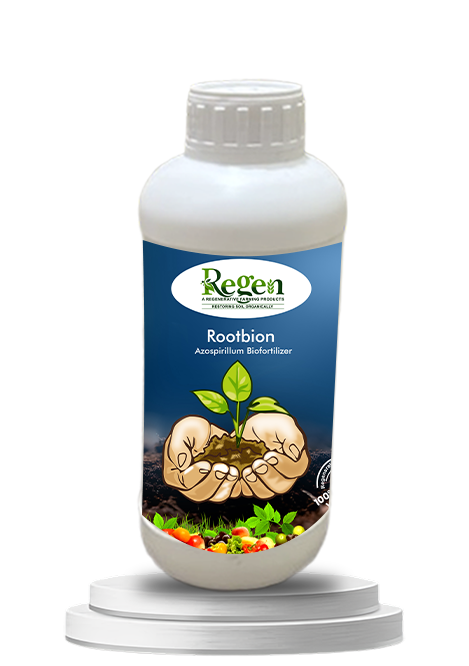
Rootbion comprises gram-negative, highly motile Azospirillum bacteria that form advantageous relationships with plant roots, predominantly in cereals and grasses, while also encompassing a diverse range of plant families, such as Solanaceae, Fabaceae, and Cucurbitaceae. In contrast to symbiotic nitrogen-fixing bacteria like Rhizobium, Azospirillum species are free-living microorganisms that colonise plant roots and the rhizosphere, making them applicable to both leguminous and non-leguminous crops.
Rootbion has emerged as a significant plant growth-promoting rhizobacteria (PGPR) that is transforming sustainable agriculture through biological nitrogen fixation, phytohormone production, and improved plant stress tolerance.
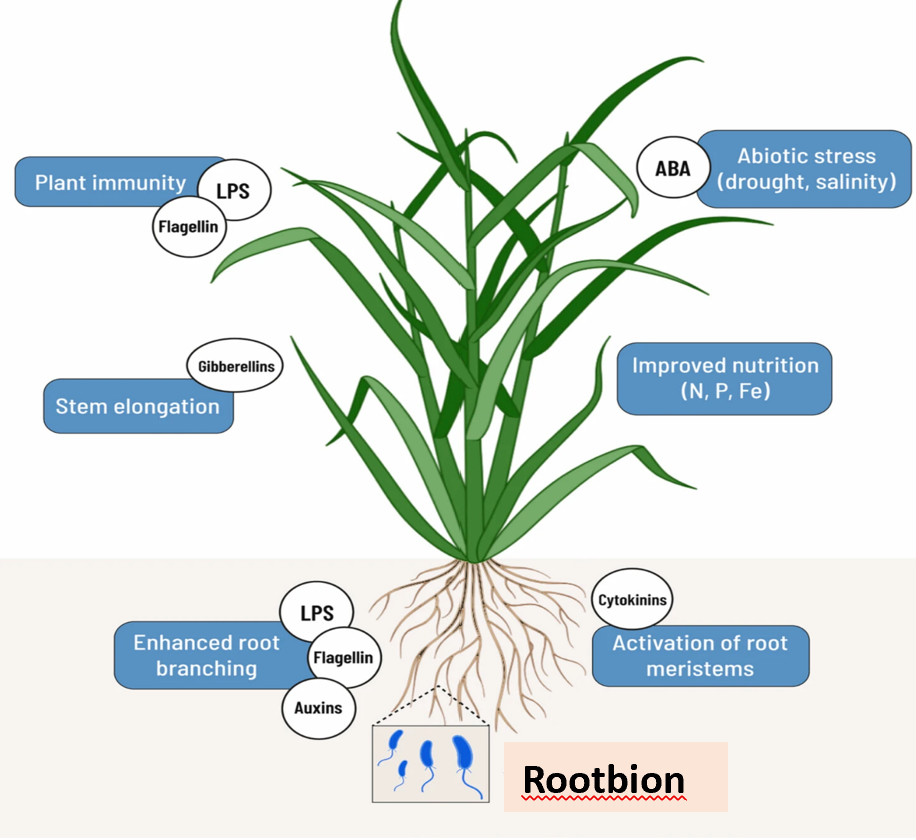
Rootbion enhances tolerance to abiotic stress through abscisic acid-mediated osmotic adjustment, while bacterial secretion of auxins and cytokinins promotes improved root development and lateral branching. Structural components like flagellin and lipopolysaccharides (LPS) act as elicitors that influence host immunity. Stem elongation may result from bacterial gibberellin sensing, while overall biomass increases are attributed to biological nitrogen fixation, enhanced phosphorus solubilisation, and improved iron uptake.
Rootbion promotes plant growth via various mechanisms of action.
1. Biological nitrogen fixation involves the conversion of atmospheric N₂ into bioavailable ammonia in microaerobic environments.
2. Phytohormone production: synthesises auxins, cytokinins, and gibberellins that promote root development.
3. Phosphorus solubilisation: converting insoluble phosphorus compounds into forms that are accessible to plants.
4. Stress tolerance enhancement: Increases plant resilience to drought, salinity, and temperature variations via induced systemic tolerance.
Mechanisms by which root symbionts confer tolerance to biotic and abiotic stresses in plants:
Tolerance to biotic stress encompasses induced systemic resistance (ISR), which is mediated by elevated levels of phytohormones within the jasmonic acid (JA)/ethylene (ET) pathway, independent of salicylic acid (SA). Additionally, systemic acquired resistance (SAR), a mechanism previously examined in relation to phytopathogens, is regulated by intermediate levels of SA. The tolerance of abiotic stresses, referred to as induced systemic tolerance (IST), is facilitated by antioxidants, osmotic adjustment, phytohormone production, and defence mechanisms, including the expression of pathogenesis-related (PR) genes.
Root biomass serves as an environmentally sustainable and economically viable substitute for chemical fertilisers, enhancing soil fertility and plant health while promoting sustainable agricultural practices.
Application Method and Dosage:
Seed treatment – Mix 5 ml of Rootbion with 50–100 ml of water for a small quantity of seeds; for treating seeds on 1 acre, mix 250 ml of Rootbion with 1–5 L of water. Thoroughly mix the Rootbion-water solution with the seed and shade-dry for one hour before sowing the treated seed.
Seedling treatment – Mix 50 ml of Rootbion with one L of water for a small number of seedlings; for treating seedlings on one acre, mix 250 ml of Rootbion with 1–5 L of water. Seedlings may be immersed in Rootbion-water solution for approximately 30 minutes prior to transplantation.
Soil Application—Mix 2.0 L of Rootbion with 10 bags of BioMitra compost per acre, and subsequently distribute this mixture in the field either prior to planting or within 45 days post-sowing in an established crop, followed by irrigation of the field.
Drip irrigation-Mix 5 ml of Rootbion in 1 L of water or 1-2 L of Rootbion per acre for each application. Apply the mixture by either drenching or dripping it onto moist soil, and repeat this treatment every 30 days to achieve optimal results.
During the crop cycle, administer 6–10 L per acre of Rootbion to achieve optimal results and reduce the application of commercial nitrogen fertiliser by up to 50%.
RootbionTM is available in packet quantities of 250 gm/ml, 500 gm/ml, and 1 kg/L.
We respect your opinion; if you have a concern, please contact the customer service representative at
Mob: 9696463077
Email: info@regenfarmtech.com
sales@regenfarmtech.com
Only for agricultural use.
Please remove the label, rinse the bottle, and return it for recycling.
Made in India.